This website is managed by Ultima Markets’ international entities, and it’s important to emphasise that they are not subject to regulation by the FCA in the UK. Therefore, you must understand that you will not have the FCA’s protection when investing through this website – for example:
You will not be guaranteed Negative Balance Protection
You will not be protected by FCA’s leverage restrictions
You will not have the right to settle disputes via the Financial Ombudsman Service (FOS)
You will not be protected by Financial Services Compensation Scheme (FSCS)
Any monies deposited will not be afforded the protection required under the FCA Client Assets Sourcebook. The level of protection for your funds will be determined by the regulations of the relevant local regulator.
Note: UK clients are kindly invited to visit https://www.ultima-markets.co.uk/. Ultima Markets UK expects to begin onboarding UK clients in accordance with FCA regulatory requirements in 2026.
If you would like to proceed and visit this website, you acknowledge and confirm the following:
1.The website is owned by Ultima Markets’ international entities and not by Ultima Markets UK Ltd, which is regulated by the FCA.
2.Ultima Markets Limited, or any of the Ultima Markets international entities, are neither based in the UK nor licensed by the FCA.
3.You are accessing the website at your own initiative and have not been solicited by Ultima Markets Limited in any way.
4.Investing through this website does not grant you the protections provided by the FCA.
5.Should you choose to invest through this website or with any of the international Ultima Markets entities, you will be subject to the rules and regulations of the relevant international regulatory authorities, not the FCA.
Ultima Markets wants to make it clear that we are duly licensed and authorised to offer the services and financial derivative products listed on our website. Individuals accessing this website and registering a trading account do so entirely of their own volition and without prior solicitation.
By confirming your decision to proceed with entering the website, you hereby affirm that this decision was solely initiated by you, and no solicitation has been made by any Ultima Markets entity.
What is pre market trading? Discover how it works, what are the key hours, its risks, and why it matters for early market sentiment and price movements.
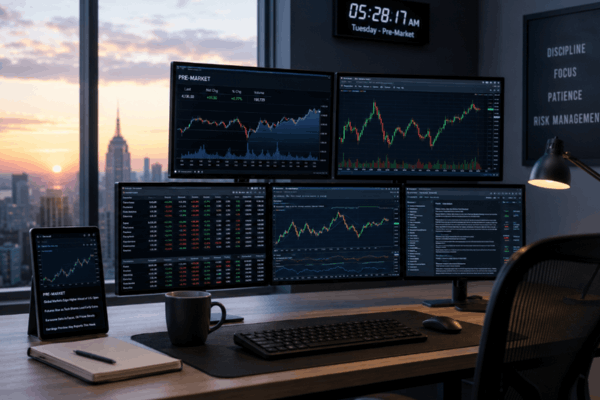
Understanding what is pre market is essential for anyone exploring how financial markets move before the official opening bell. Pre market trading gives investors and traders an early view of market sentiment, allowing them to react to news, earnings, and global developments before regular trading begins.
In simple terms, pre market refers to the trading session that takes place before the main stock market opens. Although it operates with lower liquidity and higher volatility, it often sets the tone for the day’s trading direction, especially for major indices like the S&P 500 and stocks listed on the NASDAQ and New York Stock Exchange.
What is Pre Market Trading?
To answer directly, what is pre market trading refers to the buying and selling of financial instruments before the official market opens, typically between 4:00 AM and 9:30 AM Eastern Time in the United States.
During this period, traders can react to overnight news such as earnings reports, macroeconomic data, or global market movements. However, participation is limited compared to regular trading hours, which makes price action more sensitive to smaller order flows.
So when we discuss what is pre market, we are really describing an extended trading window that allows early positioning before the main session begins.
Pre Market Hours and Trading Phases
To fully understand the pre market, it is important to break it into phases, as activity is not uniform throughout the session.
1. Early pre market (4:00–7:00 AM ET) Liquidity is extremely low, and price movements are often driven by institutional orders or overnight news reactions.
2. Active pre market (7:00–9:00 AM ET) Retail participation increases, and price discovery becomes more active. Key support and resistance levels often begin to form.
3. Pre-open window (9:00–9:30 AM ET) This is the most liquid phase of pre market trading. It often provides the clearest indication of the expected market open.
Understanding these phases helps clarify what is pre market in practice, rather than treating it as a single uniform trading period.
How Pre Market Trading Works
To understand what is pre market, we also need to look at the infrastructure behind it.
Pre market trading does not take place on the traditional exchange floor. Instead, it operates through Electronic Communication Networks (ECNs), which match buy and sell orders electronically without a centralised exchange environment.
This structure leads to several key characteristics:
Pre market volume is typically only 5% to 15% of regular session volume
Bid-ask spreads can widen by 5 to 10 times compared to normal hours
Orders may experience slippage due to thin order books
Price movements can be exaggerated by relatively small trades
For example, if a major company listed on the NASDAQ releases earnings before the bell, its share price may react sharply in pre market trading even before broader investor participation begins.
These mechanics are crucial to understanding the pre market, as they explain why prices can behave very differently compared to the regular session.
What Drives Pre Market Moves
A key part of understanding what is pre market is recognising what actually moves prices during this period.
Pre market movements are typically driven by catalysts such as:
Corporate earnings announcements before market open
Economic data releases like inflation or employment figures
Analyst upgrades or downgrades
Global market reactions from Asia and Europe
Geopolitical or breaking news events
These factors create early sentiment that influences how markets may open.
However, it is important to note that what is pre market does not always reflect the final direction of the day. Due to low liquidity, many pre market moves can reverse once the regular session begins and institutional volume enters the market.
For this reason, experienced traders use pre market activity as a sentiment indicator rather than a prediction tool.
Risks and Limitations
While learning what is pre market can provide valuable insight, it is equally important to understand its risks.
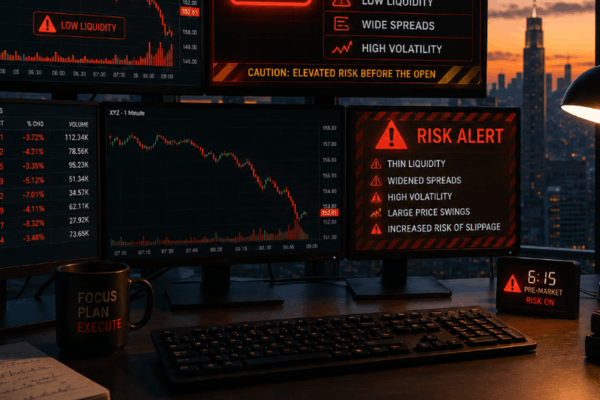
One of the biggest limitations is low liquidity. With fewer participants in the market, even small orders can cause significant price swings. This often results in less stable price discovery.
Another risk is wider spreads. Because there are fewer buyers and sellers, the difference between bid and ask prices can become significantly larger than during normal trading hours.
There is also a higher chance of false signals. Pre market moves may appear strong but can reverse quickly when full market participation resumes at the opening bell.
Finally, not all brokers offer full access to pre market trading, and execution quality may vary depending on the platform.
These risks highlight why understanding what is pre market is not just about opportunity, but also about caution and proper risk awareness.
Conclusion
In summary, what is pre market refers to the trading activity that occurs before the official market opens, allowing investors to react early to news and global developments. It plays an important role in shaping early sentiment for major indices such as the S&P 500 and stocks listed on the NASDAQ and the New York Stock Exchange.
However, while pre market trading offers early insight, it comes with lower liquidity, higher volatility, and less reliable price signals. For this reason, traders should treat it as a context tool rather than a definitive forecast of market direction.
FAQs
What time does pre market trading start?
In the US, it typically starts at 4:00 AM Eastern Time.
Is pre market trading reliable for predicting the market?
Not always, as low liquidity can cause temporary price distortions.
Why is pre market trading important?
It helps traders react early to news and gauge market sentiment before the open.
Share Now
Disclaimer:This content is provided for informational purposes only and does not constitute, and should not be construed as, financial, investment, or other professional advice. No statement or opinion contained herein should be considered a recommendation by Ultima Markets or the author regarding any specific investment product, strategy, or transaction. Readers are advised not to rely solely on this material when making investment decisions and should seek independent advice where appropriate.
Thank you for visiting the Ultima Markets website. Please note that this website is intended for individuals residing in jurisdictions where access is permitted by law. Ultima and its affiliated entities do not operate in your home jurisdiction.
By clicking ‘Acknowledge’, you confirm that you are entering this website solely on your own initiative and not as a result of any specific marketing outreach. You wish to obtain information from this website based on reverse solicitation principles, in accordance with the applicable laws of your home jurisdiction.